Agrimony
Agrimonia eupatoria L.
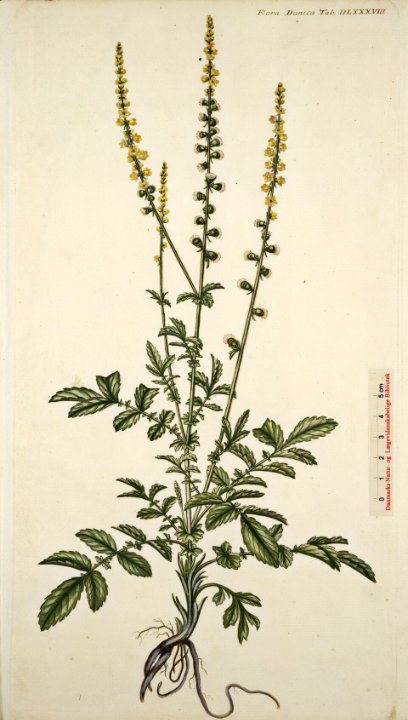
Agrimony (Agrimonia eupatoria) is a tall, slender perennial with small yellow flower spikes and burr-like seed heads that cling to clothing, common along hedgerows and field edges.
Last reviewed October 7, 2026
Members can save items to My Herbarium
Members can track this on their Apothecary Shelf
What is Agrimony?
Origin: Europe, temperate Asia, and North Africa
What is Agrimony traditionally used for?
Traditionally used as a gentle astringent for digestive comfort, particularly loose stool, and as a gargle for throat and mouth irritation. A long-standing presence in European folk herbalism. Its astringent tannins also give it a long history as a topical wound herb: traditionally applied as a cooled, strong tea or diluted tincture compress to help clean, minor cuts, scrapes, and slow-healing skin close and heal, an application modern research on its antibacterial and tissue-repair activity has helped explain.
How is Agrimony prepared?
Most commonly prepared as an infusion from the dried aerial parts; also used as a mouth rinse or gargle for its astringent property. For topical wound care, a cooled, well-strained strong infusion (or a diluted tincture in cooled boiled water) can be used as a compress or wash over the affected area.
Dosage: Infusion: roughly 1-2 teaspoons of dried herb per cup, steeped 10 minutes.
Is Agrimony safe to use?
Generally considered a mild, gentle herb. Its astringent tannin content means it's best taken separately from meals containing iron or other minerals, since tannins can interfere with mineral absorption if taken together regularly. Limited safety data exists for pregnancy and breastfeeding, so caution is reasonable there. For topical wound use: this is intended for minor cuts and scrapes only — seek medical care for deep, large, or infected wounds rather than relying on a home compress alone.
This is educational information, not medical advice. See our full Disclaimer before use.
What else is Agrimony called?
- Church Steeples (England)
- Cocklebur
Recipes Featuring Agrimony
More Like This
Gallery

Used in rituals & traditions
The symbolic and spiritual side of Agrimony is kept in the Cauldron:
- Planetary & elemental correspondence
- Where it appears in the tarot
- Folklore & spiritual associations